- Keep mapped hazard, property-specific history and insurance coverage in separate records.
- Compare the actual definitions, selected endorsements, exclusions, limits and conditions for this address and intended use.
- A quotation, drainage improvement or seller's policy cannot establish your bound coverage or guarantee a future claim.
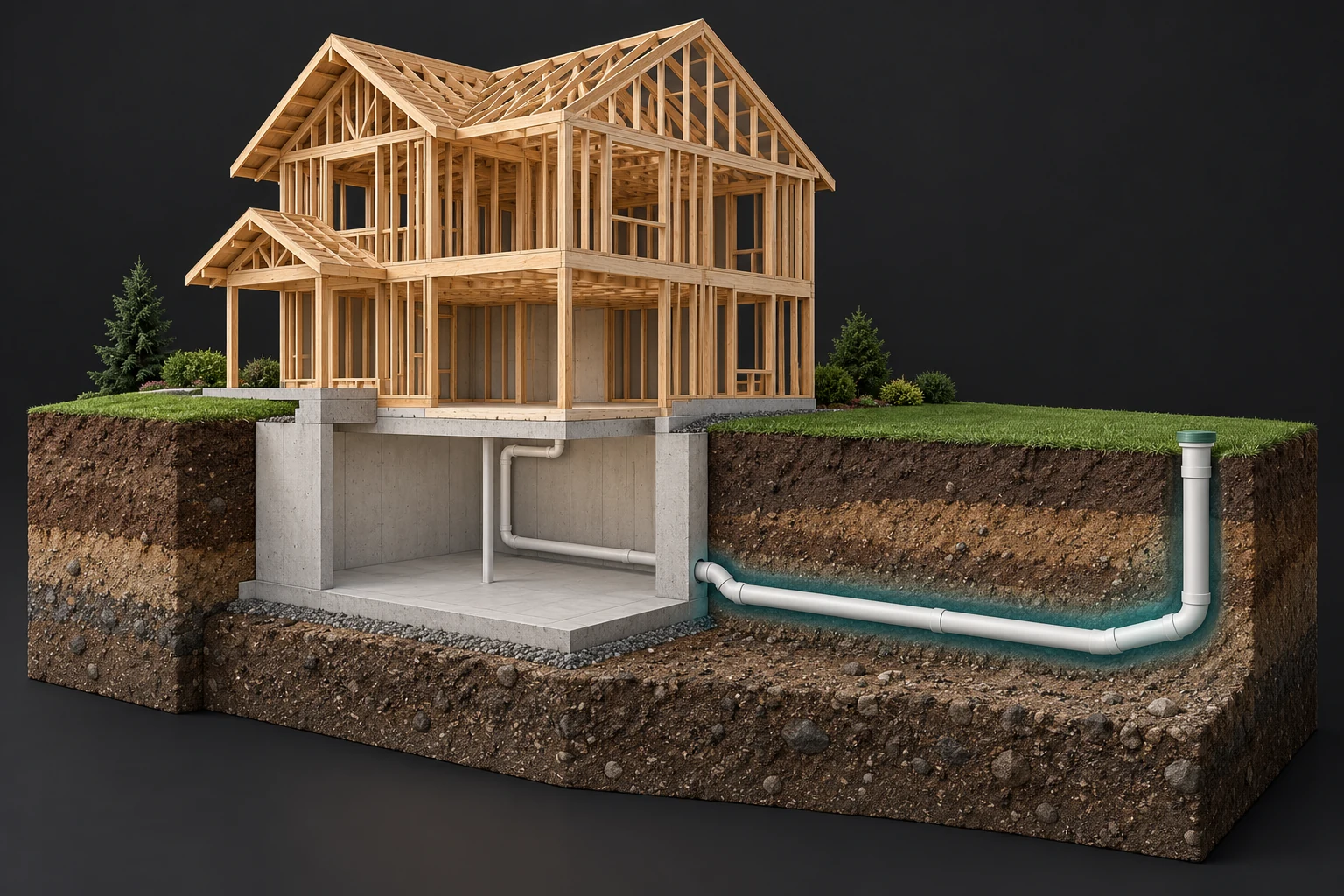
Conceptual architecture. Layout, sizes and routes are illustrative; the picture does not describe your home’s condition.
Explore this in the visual atlas ↗3 picture lessons appear beside the questions in this guide. Use them to understand the explanation, then consider what it means for your home.
Why do site risk and policy coverage need separate files?
A flood assessment asks what processes may affect a site or building and what evidence supports that view. Insurance asks what an actual contract provides for the insured property, person, use, period and loss circumstances. A useful answer to either question can leave the other unresolved. A public map cannot certify a policy, and an available endorsement cannot certify the condition of a basement.
Keep three linked records: mapping context, the property's event and technical history, and the buyer's insurance response and documents. Give each a source, date, address or study identity, scope and open questions. Connect them where relevant without merging their conclusions. For example, a seller's repair account can prompt both a drainage assessment and an accurate insurer enquiry.
The foundation and climate companions explain water-route observations and site assessment. This guide owns the additional coverage file and the comparison between records. HomeAI can organize questions and definitions, while qualified assessors, insurance representatives and transaction advisers address their actual scopes. The file is useful because uncertainty stays visible rather than becoming a pass/fail label.
Which water mechanisms should the insurance conversation name?
Describe the observed or reported mechanism without assigning a contract definition yourself. Water escaping plumbing, reverse flow through a drain, surface water entering an opening and water reaching a below-grade wall can raise different questions. More than one process may be plausible during the same event. A stain's location alone cannot establish its cause or the applicable coverage.
Intact's public house-insurance page separates basic water damage, sewer backup, exterior water/sewer service lines, overland water and ground water. It also says protections vary by province. This named insurer example teaches category separation; it is not a recommendation, the reader's issued wording or evidence that every category is available together at a particular home.
IBC's flood guidance explains that groundwater/seepage protection and sewer backup can require optional coverage and vary between policies. Ask the representative to map each relevant question to the actual form, definition and selection. Keep their written explanation beside those forms. Do not replace this exercise with the reassuring phrase water damage covered or a neighbour's experience with a different contract.
The water mechanism and policy question are separate.
The model connects rooms, weather-facing surfaces and the ground. Its purifier and exterior shade represent different functions.
Numbers identify the parts explained below.
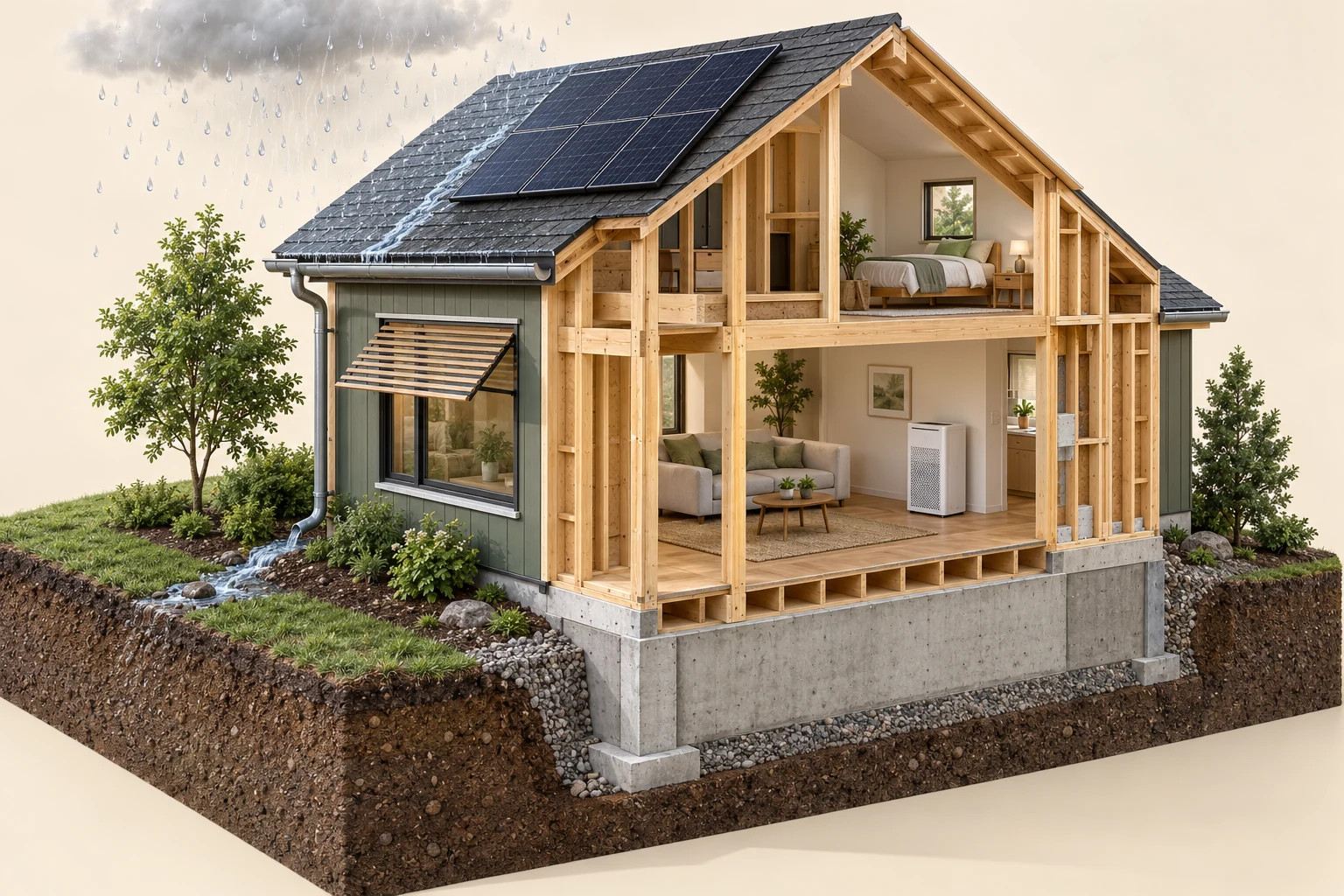
- Weather-facing roof
Observe safely from accessible ground; do not infer a cause from one mark.
- Room equipment
Confirm what the device does and the scope of its performance information.
- Ground connection
Site and buried conditions differ from the visible room.
What does this illustration leave out?
Exposure, airflow, filtration, moisture, foundation condition and parcel risk require specific evidence. This illustration explains an idea. It is not an installation guide.
Which water mechanism does the site evidence describe, and how is that mechanism treated in the actual policy?
Explore this with HomeAI ↗Opens an editable question. Nothing is sent until you choose to send it.What does a flood map establish, and what does it omit?
Retain the authority, study name, map type, draft or final status, scenario and relevant date. Ask whether the exact area is covered and what processes are assessed. Alberta's December 2023 flood-study publication explains a specific scope: provincial studies assess river water escaping into the floodplain, while groundwater, local drainage and excessive rain- or snowmelt-runoff flooding are outside that assessment.
Its explanation of a 1:100 flood is an annual one-percent chance, rather than a calendar schedule that allows only one event per century. Protected areas behind berms can still have residual risk. These are named Alberta study explanations, not an address-level probability calculated by this guide. The provincial viewer also notes that mapping is unavailable in some communities; no map coverage is a gap rather than evidence of no hazard.
Ask the municipality or mapping authority about the applicable product and any separate local information. Alberta's publication says insurers commonly use proprietary maps that may include other factors. That is why a favourable public-map screenshot and a restrictive insurance response need not describe the same assessment. Preserve both and request an explanation rather than assuming one must be wrong.
A map and a ground observation have different limits.
The foundation supports the house above it. Beside the wall, a downspout brings roof water to a splash block, while the yard provides the next part of the surface-water path. The drawn crack gives us a place to discuss an observation; it is not a finding at a real home.
Numbers identify the parts explained below.
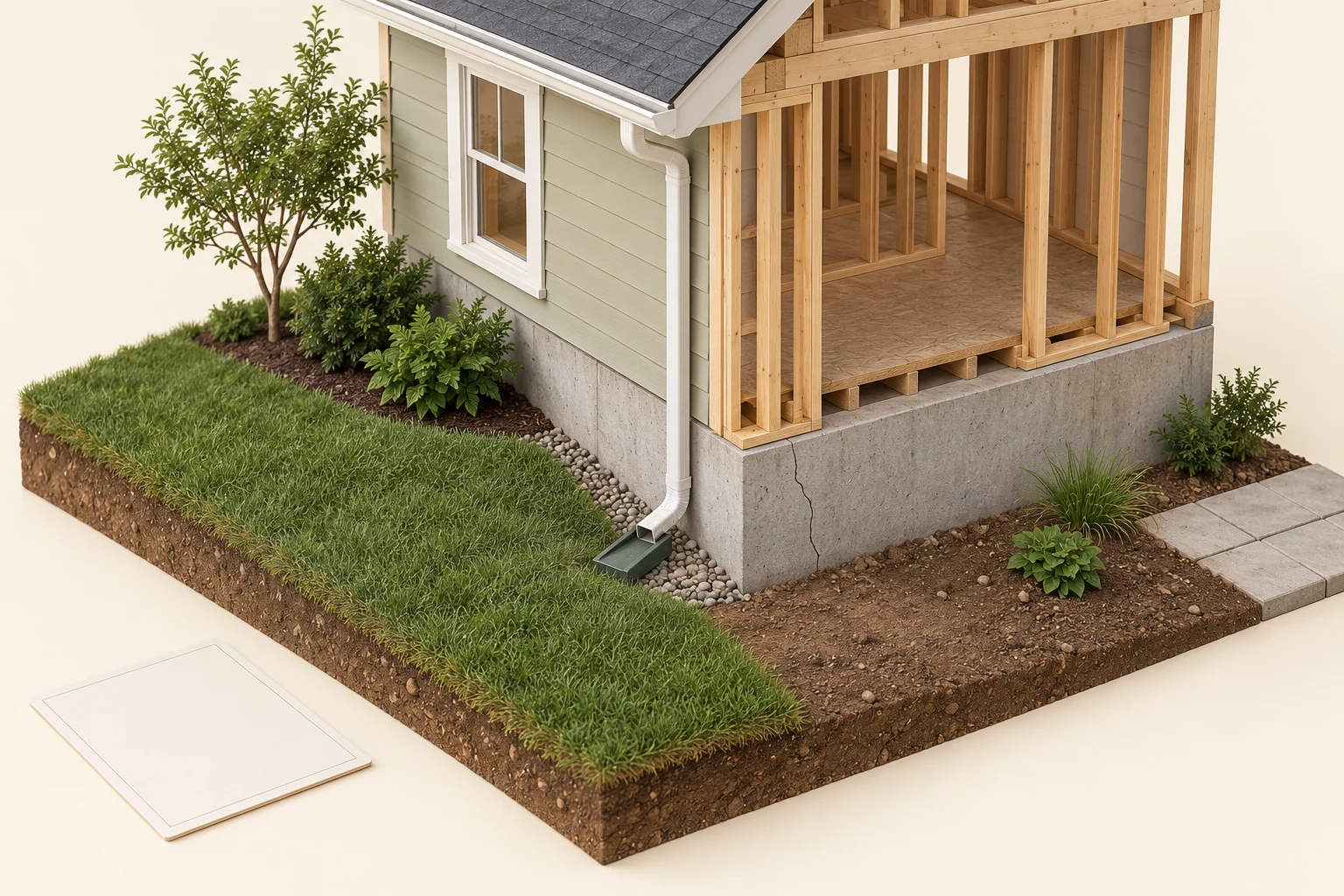
- Grading and work records
A grading record describes levels or work within its stated scope and date. Ask for the actual document and its status, rather than treating the blank card as an approval. A later yard alteration may need its own record.
- Grass meets soil
This change in surface finish gives you a useful location to compare with the file. Ask whether the shown levels were recorded before or after landscaping and whether any unfinished work remains. The picture itself gives no measured slope.
- Foundation observation
Keep dated crack or moisture observations beside the relevant yard records. Together they help a qualified assessor ask better questions, but a grading document alone cannot establish why a crack or water event occurred.
What does this illustration leave out?
The scene supplies no crack measurements, movement history, surveyed ground levels or observed water flow. It cannot identify the cause of a real crack or establish structural condition. Local grading requirements and any repair need a property-specific assessment. This illustration explains an idea. It is not an installation guide.
What hazard and mapping method are shown, which mechanisms are omitted, and what address-specific evidence is still needed?
Explore this with HomeAI ↗Opens an editable question. Nothing is sent until you choose to send it.How should a buyer read the property's reported flood history?
Request dated accounts, original photographs, assessments, repair scopes and follow-up observations. Distinguish who reported an event, which locations were affected, what cause was professionally established and what remains unknown. A general statement that water entered once leaves important questions open. A statement that nobody recalls water is also limited by the reporter's knowledge and period of ownership.
Use the records to define further technical assessment when the purchase warrants it. A finish-restoration invoice may establish completed surface work while leaving the original route unresolved. A drain or grading intervention has its own scope and does not silently become confirmation that every flood process was eliminated. Keep concealed areas, dry-weather access and missing records explicit.
Provide accurate relevant information when asking the insurer about the address and intended use, and seek transaction advice on disclosure and document requests. This guide cannot decide a legal duty or a claim outcome. If flooding is present, safety comes first: stay clear of water near electrical equipment or suspected contamination and arrange appropriate emergency, utility or professional help.
How is a quotation different from an effective policy?
Ask the representative to identify the insurer, applicant, exact property, intended occupancy and use, requested effective date, proposed selections and outstanding conditions. Keep a quotation identified as a quotation. A price, application acknowledgement or verbal statement does not establish that the arrangement has been bound and remains effective for the buyer's circumstances.
Request the applicable policy wording, declarations and endorsement forms, then obtain the representative's explicit confirmation of the actual effective arrangement and any outstanding requirements. Match the form numbers and edition identifiers where supplied. Preserve any condition attached to acceptance rather than removing it from the summary because the headline price looks attractive.
The seller's policy can provide useful context without establishing transfer, the buyer's eligibility or the buyer's future terms. If an important response is still pending at the real transaction deadline, discuss that unresolved matter with the appropriate adviser. Time pressure should lead to a decision about uncertainty, rather than an invented conclusion that insurance is assured.
Which policy pages belong together when comparing coverage?
IBC explains that declarations contain insured-party information, effective dates, limits, deductibles and form references. An endorsement can add, change, limit or restrict coverage. Read these with the insuring agreement, exclusions and conditions; a broad title on the declarations is not a substitute for the selected forms and their wording.
Build a comparison with one row for each water question: requested protection, form or section, selected status, limit, deductible, exclusion or condition, representative's explanation and outstanding action. Use supplied facts rather than filling missing fields with assumptions. A missing answer should remain unknown, even when another quote includes a similarly named package.
Ask which parts of a potential loss the response concerns: building, contents, additional living expenses, exterior infrastructure or another stated category. IBC describes additional living expenses as dependent on the policy and circumstances of insured damage. Do not silently extend a water limit to every category or assume temporary accommodation will always be paid. The actual forms and explanation should resolve the comparison.
Read the policy file beside the physical question.
The foundation supports the house above it. Beside the wall, a downspout brings roof water to a splash block, while the yard provides the next part of the surface-water path. The drawn crack gives us a place to discuss an observation; it is not a finding at a real home.
Numbers identify the parts explained below.
- Grading and work records
A grading record describes levels or work within its stated scope and date. Ask for the actual document and its status, rather than treating the blank card as an approval. A later yard alteration may need its own record.
- Grass meets soil
This change in surface finish gives you a useful location to compare with the file. Ask whether the shown levels were recorded before or after landscaping and whether any unfinished work remains. The picture itself gives no measured slope.
- Foundation observation
Keep dated crack or moisture observations beside the relevant yard records. Together they help a qualified assessor ask better questions, but a grading document alone cannot establish why a crack or water event occurred.
What does this illustration leave out?
The scene supplies no crack measurements, movement history, surveyed ground levels or observed water flow. It cannot identify the cause of a real crack or establish structural condition. Local grading requirements and any repair need a property-specific assessment. This illustration explains an idea. It is not an installation guide.
Which declarations, wording, endorsements and deductible definitions form the effective policy for this address?
Explore this with HomeAI ↗Opens an editable question. Nothing is sent until you choose to send it.Why do deductible and occurrence definitions change the comparison?
A headline limit is incomplete without its boundary. Ask whether a water-category limit is separate, shared, subject to another cap or applied per defined occurrence, and which deductible applies. Avoid adding displayed limits together until the contract's interaction is established. These questions can materially change what two similar-looking quotations describe without forecasting any claim payment.
A named document illustrates the issue. Intact's Alberta Personal Property Manual has a cover updated July 31, 2025, while selected AB, NT, NU, YK water-package sections retain April 2024 stamps. Those sections describe groundwater as an optional selection under stated conditions and group applicable sewer-backup, overland-water and groundwater events within 168 consecutive hours as one occurrence with one deductible and limit.
This is an example from a product manual, not a reader's issued contract or proof those terms remain applicable in a current offer. It shows why package names and multiple water categories cannot automatically become separate payable limits. Ask the representative to explain the current forms for the proposed policy, including mixed or repeated events, without asking HomeAI to predict a settlement.
Does a sump, backwater device or grading repair prove coverage?
A mitigation device addresses a technical task in an actual configuration. Insurance acceptance or a pricing adjustment is a separate insurer response. Provide the identity, professional installation or service evidence and any requested findings accurately, but do not assume that owning a device guarantees eligibility, an incentive or a future claim.
Technical scope still matters. A sump may depend on power and a suitable discharge; a backwater device protects identified routes; grading manages particular surface conditions. None is a universal answer to river flooding, all groundwater entry or an unknown plumbing event. Use the companion guides for those assessments and retain their exclusions beside the insurance enquiry.
If the insurer requests work or evidence, ask what is required, who can establish it and how completed submission and acceptance will be confirmed. Keep a proposal, completed job and accepted requirement separate. A seller can hand over genuine receipts and findings; a buyer should avoid describing an unverified installation as certified flood protection merely to satisfy a form.
How do a new home or shared property change the questions?
A new home's completed finishes and building approvals do not establish the buyer's water coverage or the entire site's future performance. Tell the representative the actual possession, occupancy and intended use, including any unfinished work relevant to the enquiry. Ask which conditions apply during construction, vacancy, renovation or later changes instead of assuming the ordinary occupied-home description fits every stage.
For a condominium or other shared arrangement, obtain the applicable corporation and unit-owner insurance documents and qualified explanation of responsibilities. Identify whose insured property and policy a particular question concerns. Ask about the actual water definitions, deductibles, unit improvements and any assessment-related protection without assuming that the common policy covers everything the household owns or may owe.
The property-type companion owns the wider responsibility and record review. Here the task is to connect those facts to the insurance enquiry. Keep a rental or proposed secondary use explicit too. An existing owner-occupied quote cannot silently stand for a different use, and the guide does not decide a permitted use, statutory responsibility or coverage entitlement.
How would a fictional buyer close the evidence gaps?
A fictional buyer sees a dry finished basement, receives a seller's account of earlier water near one wall and finds the site outside one mapped river scenario. A quote is headed enhanced water protection but does not supply the selected groundwater form or explain whether water-category limits interact. The buyer retains three different records, each with a different unanswered question.
The agent coordinates authorized history requests and a defined specialist assessment. The buyer sends the relevant address, intended use and history to the insurance representative and requests the missing forms and explanation. Their transaction adviser addresses the actual decision deadline. No source of water, binding acceptance or legal obligation is invented from the screenshot or quotation.
Suppose technical assessment narrows one local route while the insurance response remains conditional. That condition stays in the decision file with its owner and next action. For a seller, useful preparation means preserving the original history and completed scopes; after possession, the household retains effective policy documents and updates material changes with its representative. This example proves no safe parcel, guaranteed coverage, transferable policy or future payment.
Keep learning about the connected parts
Practice the distinction.
A favourable map and a package title leave different gaps
Fictional learning scenario: a buyer has a dry showing, limited reported water history, a river-map screenshot and an incomplete enhanced-water quotation.
Reported observations
- The map describes one river scenario, with other processes outside its scope.
- The earlier wall-water account needs cause and repair clarification.
- The quote omits selected groundwater-form and limit-interaction details.
Compare the explanations
Expand each possibility to see the evidence needed to distinguish it. Similar symptoms can have different mechanisms.
A local route can be assessed within a defined scope
The history and technical records may clarify a building or site mechanism independently of the map.
Dated accounts, original repair scope and a qualified location-specific assessment.
The proposed insurance arrangement remains conditional or incomplete
A package heading may leave selection, wording, effective status or conditions unanswered.
Current address-specific representative confirmation, applicable forms and documented outstanding requirements.
A useful next question
Coordinate the technical and insurance requests separately, then retain unresolved matters in the actual transaction decision.
No parcel diagnosis, insurability, legal duty, bound policy, transferred rights or future claim payment is established.
Know what the words mean.
- Mapped flood scenario
- The stated process and conditions represented by a particular study product, rather than a complete parcel assessment.
- Coverage evidence file
- The address- and use-specific insurance response, declarations, selected forms, conditions and effective-arrangement confirmation.
- Endorsement
- A policy addition that can change, add, limit or restrict coverage; its actual wording and selection matter.
- Deductible
- The amount the insured is responsible for under the applicable policy provisions, kept separate from the coverage limit.
- Occurrence boundary
- The contract's rule for grouping relevant events or losses for purposes such as applying a limit or deductible.
- Residual mapped risk
- Risk that remains within the study's stated assumptions even where a protective feature or mapped boundary is present.
Questions to bring
to the conversation.
- Which mapped process, study status, scenario and coverage describe the actual location?
- What dated water-event, cause, repair and follow-up records are available for the property?
- Has the insurance representative received the address, occupancy, intended use and relevant history?
- Which actual forms and selected endorsements describe the requested water routes?
- What limits, deductibles, occurrence grouping and exclusions need explanation?
- Which confirmation establishes the buyer's effective arrangement, and what remains conditional?
- Who owns unresolved technical, insurance and transaction questions before the decision deadline?
Separate a showing observation, an existing record and a new professional assessment. Unknown means a question remains; it does not automatically mean a defect.
Use the evidence planner ↗Go to the source.
Original HomeAI explanation informed by these public references. Sources support the underlying guidance; they have not reviewed or endorsed HomeAI. Diagrams are conceptual, and calculator outputs depend on your inputs.
Publication & source review
First published .
Sources reviewed .
- Government of Alberta · General information about flood studies, December 2023
Where this reference applies
Jurisdiction: Alberta provincial river-flood studies; December 2023 publication
Printed pages 1–4 explain assessed river processes and excluded groundwater/local drainage/rain-or-snowmelt runoff, annual probability, berm residual risk, municipal development responsibility and insurer proprietary maps. No parcel diagnosis, current development permission or insurance determination.
- Government of Alberta · Flood Awareness Map Application
Where this reference applies
Jurisdiction: Alberta; coverage and selected map products vary by study
Definitions distinguish hazard and inundation products and available scenarios; unmapped areas can still face flood risk. No address was assessed or flood-depth value taken for a real property.
- Insurance Bureau of Canada · Flooding and insurance
Where this reference applies
Jurisdiction: Canada; insurance-industry consumer education
Optional and variable water coverages, groundwater/seepage and additional-living-expense limits, and safe claim documentation. General advice is not a policy wording or promise about a property, insurer, claim or available product.
- Insurance Bureau of Canada · Know your policy
Where this reference applies
Jurisdiction: Canada; insurance-contract education
Declarations, effective dates, form numbers, endorsements, deductibles, insuring agreements, exclusions and conditions. No interpretation of the reader's contract or confirmation of binding coverage.
- Intact Insurance · House insurance and water-damage categories
Where this reference applies
Jurisdiction: Canadian insurer product information; protections vary by province and actual product
Public product page separately identifies basic water, sewer backup, water/sewer service lines, overland and ground water. Marketing descriptions are not the issued policy or a property-specific offer.
- Intact Insurance · Alberta Personal Property Manual, cover updated July 31, 2025
Where this reference applies
Jurisdiction: Named insurer manual; selected water-package sections marked AB, NT, NU, YK (04-2024), not all Canadian policies
Captured 143-page PDF: cover date July 31, 2025; PDF pages 90–91 retain April 2024 section stamps and illustrate conditional groundwater selection and a 168-consecutive-hour occurrence grouping. This product manual is not a reader's issued wording or proof these terms remain available/applicable in a current quotation. Rates, eligibility zones and discount percentages are not reproduced.
- Electrical Safety Authority · Flood safety
Where this reference applies
Jurisdiction: Ontario; electrical flood safety and restoration process
Avoid flooded electrical areas, arrange utility isolation, do not repair water-affected electrical systems yourself, qualified review before restoration. The Ontario ESA/LEC process remains locally scoped; an outage is not proof all sources are isolated.
Have a question about your home?
Start with the symptom, timing and what you have observed.
Ask HomeAI